
CHRONIC WOUND TREATMENT: AUREALIS MULTI-TARGET BACTERIAL GENE THERAPY (AUP-16)
WE HEAL CHRONIC WOUNDS WITH OUR MULTI-TARGET CELL AND GENE THERAPY PLATFORM
Chronic wounds are non-healing wounds that fail to progress through the normal stages of wound healing within a reasonable time, usually six weeks, and that may never fully heal. Chronic wounds can affect any part of the body, but are most common in the lower extremities, particularly the feet, ankles and legs.
Chronic wounds are a major public health problem. Between 1% and 2% of the world population will experience a chronic wound at some point in their lives; this represents between 123 and 246 million people worldwide and 15 million every year! Chronic wounds can be caused by a variety of factors, including diabetes and obesity, peripheral artery disease, or venous insufficiency. Chronic wounds, such as Diabetic Foot Ulcers (DFUs) and Venous Leg Ulcers (VLUs), can be very painful and debilitating; they can lead to serious complications such as infections, amputations and even death.
BURDEN OF CHRONIC WOUNDS


Incremental improvement to chronic wound treatment is insufficient. Current wound care practices often lack precision and consistency, leading to ineffective treatment and prolonged healing times. Each year, thousands of patients undergo preventable amputations as a result of ineffective management of DFUs or VLUs. The psychological, physical, and financial burden of living with chronic wounds affects both patients and their families. The burden of chronic wounds is significant in terms of human suffering and economic cost.
INTRODUCING AUP-16: BACTERIAL GENE THERAPY
OUR SOLUTION FOR THE TREATMENT OF CHRONIC WOUNDS
We believe that, when treating chronic wounds, one needs to hit multiple targets to be disease-modifying. Very few companies or products can claim to be truly multi-target. Carefully designed and developed pharmaceutical products, such as our Advanced Therapy Medicinal Product (ATMP) AUP-16, will make the difference for patients. Our unique multi-target ATMP approach is based on a bacterial gene therapy platform and promotes the healing of the wound by supporting tissue regeneration and releasing active biological therapeutic agents within the wound itself.
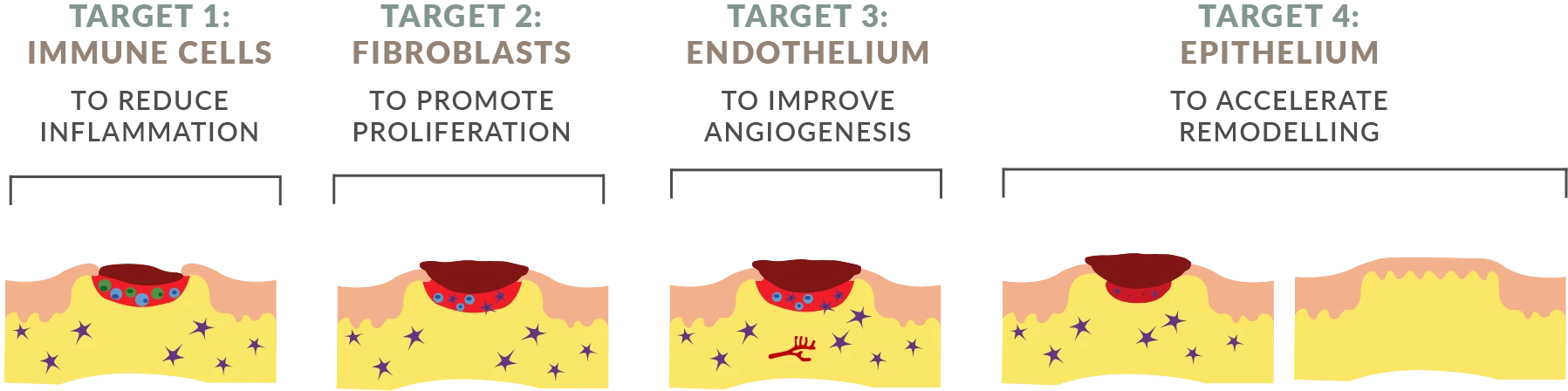
One Active Pharmaceutical Ingredient (API) product with the benefits of four therapeutics.
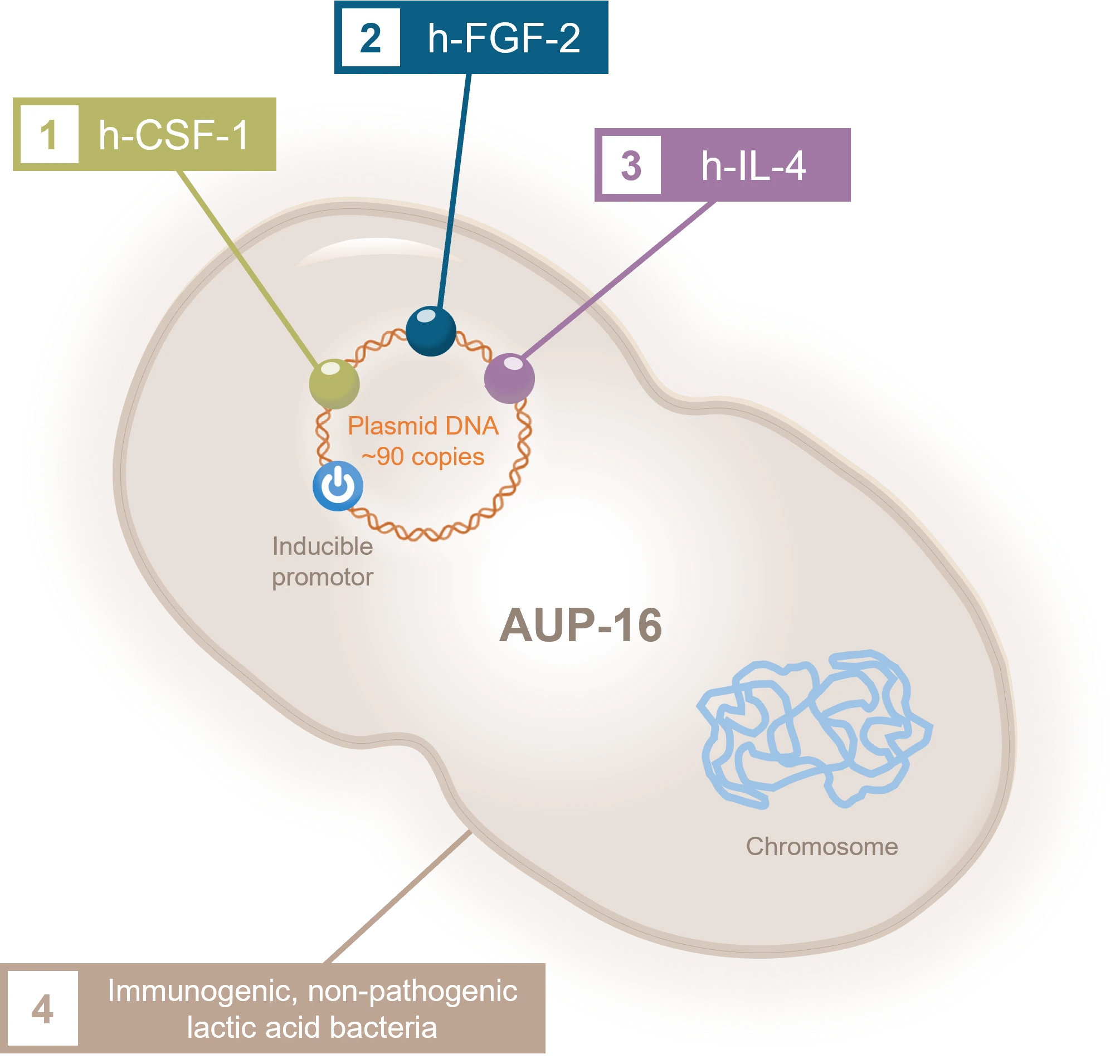
AUP-16 is a safe and effective recombinant live biotherapeutic product that features a patented active bacterial vector. AUP-16 includes four therapies in one product:
1. COLONY STIMULATING
FACTOR 1 (h-CSF-1)
A hematopoietic growth factor involved in the proliferation, differentiation, and survival of monocytes, macrophages, and bone marrow progenitor cells.
2. FIBROBLAST GROWTH FACTOR (h-FGF-2)
A clinically used growth factor and signaling protein involved in cell proliferation and tissue repair.
3. INTERLEUKIN 4
(h-IL-4)
A potent anti-inflammatory M2 cytokine that promotes regeneration.
4. LACTOCOCCUS
CREMORIS
A non-pathogenic lactic acid bacteria that acts as a bioreactor in the tissue, producing human therapeutic proteins in the wound. AUP-16 takes advantage of the safe, living bioreactor to produce proteins FGF-2, IL-4 and CSF-1.
AUP-16 is a topical treatment created using a genetically modified Lactococcus cremoris bacteria. AUP-16 promotes healing by producing three human therapeutic proteins that (1) improve cell activation and conversion to anti-inflammatory phenotype, (2) increase fibroblast proliferation, and (3) promote angiogenesis and granulation tissue formation.
The continuous production of the three human therapeutic proteins h-CSF-1, h-FGF-2 and h-IL-4 by the active vector Lactococcus cremoris at the site of the wound, results in our unique 4-in-1 combination biological treatment which is provided as one API.
AUP-16 provides multi-therapy in one product, it is not a combination product. Thanks to its multi-target approach, AUP-16 is able to reduce inflammation promote proliferation and angiogenesis, and accelerate remodeling. All in one product.
Our therapy, AUP-16, is created under Good Manufacturing Practice (GMP) conditions and analyzed using state-of-the-art methods to ensure identity, potency, consistency, and safety.
AUP-16 has the power to accelerate and provide complete wound healing, avoiding amputations. This remarkable advancement is ideal for patients who only achieve partial response to wound care dressings and treatment of symptoms.
As opposed to the existing standard of care, AUP-16 promotes tissue regeneration in the wound to activate healing from within.
AUP-16 RECEIVED PRIME STATUS FROM THE EUROPEAN MEDICINES AGENCY
In February 2024, the Committee for Medicinal products for Human Use (CHMP) and the European Medicines Agency (EMA) have acknowledge that non-healing Diabetic Foot Ulcers (nhDFUs) are a potentially life-threatening condition with unmet need for novel therapies, and that AUP-16 has the potential to address this unmet medical need.
First Aurealis Therapeutics product candidate to receive PRIME designation by EMA for enhanced regulatory support facilitating the clinical development of multi-target cell and gene therapy candidate AUP-16 in the treatment of nhDFUs.
PRIME designation follows positive data for 16 patients from Phase-1 first-in-human study showing a dose-dependent improvement in wound closure, 67% and 83% wound closure at 3 and 6 months respectively, demonstrating the potential to address the unmet medical need in nhDFUs.
HIGHLIGHTS OF AUP-16
FOUR-IN-ONE
cell and gene therapy that stimulates endogenous tissue regeneration
BIOAVAILABLE
protein production at the site of the injury
TOPICAL APPLICATION
makes it easy to administer
SAFE
modified food-grade bacteria
LEARN ABOUT AUP-16 MODE OF ACTION
SCIENTIFIC PUBLICATIONS ABOUT AUP-16
Prof. Alberto Piaggesi presented the results of our DFU Phase-2 clinical study during an oral presentation at the European Wound Management Association (EWMA) Conference Bremen 2026 titled: Results of Phase-2 Randomized Controlled “DIAMEND” Study with Multi-targeting Cell & Gene Therapy AUP1602-C in Chronic Neuro-Ischemic Diabetic Foot Ulcers. Access the presentation.
Aurealis Therapeutics had a poster presented at the Symposium on Advanced Wound Care (SAWC) Charlotte 2026 titled: Final results of Phase-2 Randomized Controlled “DIAMEND” Study In Chronic Diabetic Foot Ulcer With Topical Multi-Target Cell & Gene Therapy AUP1602-C. Access the poster.
Aurealis Therapeutics had an abstract published and an e-poster presented at the European Wound Management Association (EWMA) Conference Barcelona 2025 titled: A randomized controlled Phase 2 trial to evaluate multi-factorial gene therapy AUP1602-C in the management of non-healing Diabetic Foot Ulcer. Access the abstract. Access the e-poster.
Aurealis Therapeutics published a scientific article in the Therapeutic Advances in Endocrinology and Metabolism peer-reviewed journal titled: Multi-target gene therapy AUP1602-C to improve healing and quality of life for diabetic foot ulcer patients: a phase I, open-label, dose-finding study. Access the scientific article.
Aurealis Therapeutics presented an abstract and a poster at ISPOR Health Economic Conference titled: A Markov model to determine the cost-effectiveness of a multi-targeting bacterial gene therapy (AUP-16) at healing a Diabetic Foot Ulcer when compared to the current standard of care. Access the abstract and the poster.
Aurealis Therapeutics presented a poster at the 14th International Symposium on Lactic Acid Bacteria titled: Multi-target bacterial gene therapy for chronic wounds and cancer. Access the poster.
Aurealis Therapeutics gave an oral presentation at the European Wound Management Association (EWMA) Conference Milan 2023 titled: 4-in-1 live biotherapeutic Gene Therapy Medicinal Product (GTMP) accelerates healing of Diabetic Foot Ulcers (DFUs): a first-in-human, phase 1 clinical study. Access the oral presentation.
Aurealis Therapeutics published a scientific article in the PLOS-One journal titled: 4-in-1 Combination therapy using Lactococcus lactis expressing three therapeutic proteins for the treatment of chronic non-healing wounds. Access the scientific article.
Aurealis Therapeutics presented a poster at the European Wound Management Association (EWMA) Conference Krakow 2018 titled: Therapeutic use of Lactococcus lactis bacteria to produce proteins locally in diseased tissues of chronic wounds. Access the poster.
CLINICAL TRIALS IN CHRONIC WOUNDS
AUP-16 FOR CHRONIC WOUNDS
PHASE 1 CLINICAL STUDY IN DFU (COMPLETED)
83% of the patients achieved complete healing. No healed ulcer recurred after 12 months follow-up.
In June 2022, we successfully completed the Phase 1 study (NCT04281992 and EudraCT 2018-003415-22) in non-healing Diabetic Foot Ulcer (nhDFU) patients with our lead product AUP-16. The last patient last visit (LPLV) was on 20th March 2023. Results were presented during European Wound Management Association (EWMA) 2023 conference in Milan and published on the Therapeutic Advances in Endocrinology and Metabolism peer-reviewed journal in November 2024.
Aurealis Therapeutics technology platform works in real life: non-healing diabetic wounds heal. Clinical results: 83% of patients reached complete healing, no healed ulcer recurred after 12 months follow-up.
More details about our Phase 1 Clinical Study:
NIH National Library of Medicine record
More details about our Phase 1 Clinical Study:
EU Clinical Trials Register
PHASE 2 CLINICAL STUDY IN DFU
AUP-16 DIAMEND Phase 2 RCT in Diabetic Foot Ulcer completed in Germany, Italy and Poland.
AUP-16 Phase 2 study (NCT06111183 and EudraCT 2022-502048-10-00) in DFU received CTA approval in May 2023. It is a multi-center, single-blinded, randomized, standard-of-care plus placebo-controlled study in patients with nhDFUs, conducted in Germany, Italy and Poland. The first DFU patient was dosed in August 2023 and the last patient last treatment (LPLT) was completed in October 2024. Blinded evaluator data is expected in Q3 2025.
More details about our DIAMEND Phase 2 Clinical Study:
NIH National Library of Medicine record
More details about our DIAMEND Phase 2 Clinical Study:
EU Clinical Trials Register
PHASE 2 CLINICAL STUDIES IN VENOUS LEG ULCER (VLU) AND PRESSURE ULCER (PU) WILL FOLLOW.
CHRONIC WOUNDS: AUP-16

CHRONIC WOUNDS | AUP-16
| Modality | Product | Discovery | In vivo POC | GLP, S&T, CMC | IND/CTA | Phase 1 | Phase 2 | Phase 3 | NDA/MAA |
|---|
Do you want to knoW more about our lead asset aup-16?
Frequently Asked Questions
01. What is an Advanced Therapy Medicinal Product (ATMP), and why is AUP-16 classified as one?
An Advanced Therapy Medicinal Product (ATMP) is a medicine based on genes, cells, or tissue engineering — regulated in Europe under a specialized framework by the EMA. AUP-16 is classified as a Gene Therapy Medicinal Product (GTMP) because its active component is a genetically engineered Lactococcus cremoris — a non-pathogenic, food-grade lactic acid bacterium — engineered to continuously secrete therapeutic human proteins at the wound site. ATMP classification means AUP-16 undergoes a dedicated regulatory review pathway, including PRIME designation — a scheme reserved for medicines that address an unmet medical need.
02. What results has AUP-16 shown in clinical trials for diabetic foot ulcers?
In the completed Phase 1 study, 83% of patients with non-healing diabetic foot ulcers achieved complete wound closure at the recommended Phase 2 dose, with zero recurrences during 12 months of follow-up [1]. In the Phase 2 DIAMEND randomized controlled trial (64 patients, 10 sites across Germany, Italy, and Poland), AUP-16 administered twice weekly achieved a complete wound closure rate of 64% versus 20% in the placebo group (+44%, p < 0.05, Per Protocol population) and 60% versus 24% (+36%, p < 0.05, Intention-to-Treat population), both in patients with chronic DFUs of more than three months’ duration. No serious adverse reactions or safety concerns related to AUP-16 were observed [2]. Final DIAMEND results were presented by Prof. Alberto Piaggesi at the EWMA 2026 conference in Bremen, May 2026.
References:
03. How is AUP-16 administered to a chronic wound?
AUP-16 is administered as a topical treatment applied directly to the wound surface, making it straightforward to use within existing wound care workflows without the need for surgery or injection. The genetically modified Lactococcus cremoris bacteria in AUP-16 then act as living bioreactors within the wound, continuously producing the three therapeutic proteins — h-CSF-1, h-FGF-2, and h-IL-4 — at the site of injury. This local, sustained protein delivery is what distinguishes AUP-16 from single-dose growth factor treatments that degrade rapidly after application.
04. How does AUP-16 differ from existing chronic wound treatments?
Existing chronic wound therapies — including becaplermin (a single growth factor), bioengineered skin substitutes, and negative pressure wound therapy — each address only one aspect of the disrupted healing cascade. AUP-16 simultaneously targets all four impaired healing stages: chronic inflammation (via IL-4-driven M2 macrophage conversion), granulation tissue formation and fibroblast activity (via FGF-2), immune microenvironment remodeling (via CSF-1), and vascular repair.
05. What other chronic wound types will AUP-16 be developed for beyond diabetic foot ulcers?
Following the completion of Phase 2 clinical development in diabetic foot ulcers, Aurealis Therapeutics plans to extend AUP-16 into two additional chronic wound indications: venous leg ulcers (VLUs) and pressure ulcers (PUs). Both conditions share the same multi-factorial healing failure seen in DFUs — persistent inflammation, impaired angiogenesis, and insufficient tissue regeneration — making them biologically suited to AUP-16’s multi-target mechanism. Phase 2 studies in VLU and PU are planned as part of the broader AUP-16 development programme.
06. What regulatory pathway is AUP-16 following toward marketing authorization in Europe?
AUP-16 is advancing under the EMA’s PRIME designation, which was granted in February 2024 for the treatment of non-healing diabetic foot ulcers. PRIME provides enhanced regulatory interaction and scientific guidance throughout development, designed to accelerate the path to a Marketing Authorization Application. Following the completion of its Phase 2 clinical trial, Aurealis continues to advance AUP-16 toward the next stage of development. As we move into Phase 3, continued collaboration across the wound care community will play an important role.