
Aurealis Pipeline: Multi-Target Bacterial Gene Therapy for Chronic Wounds and Cancer
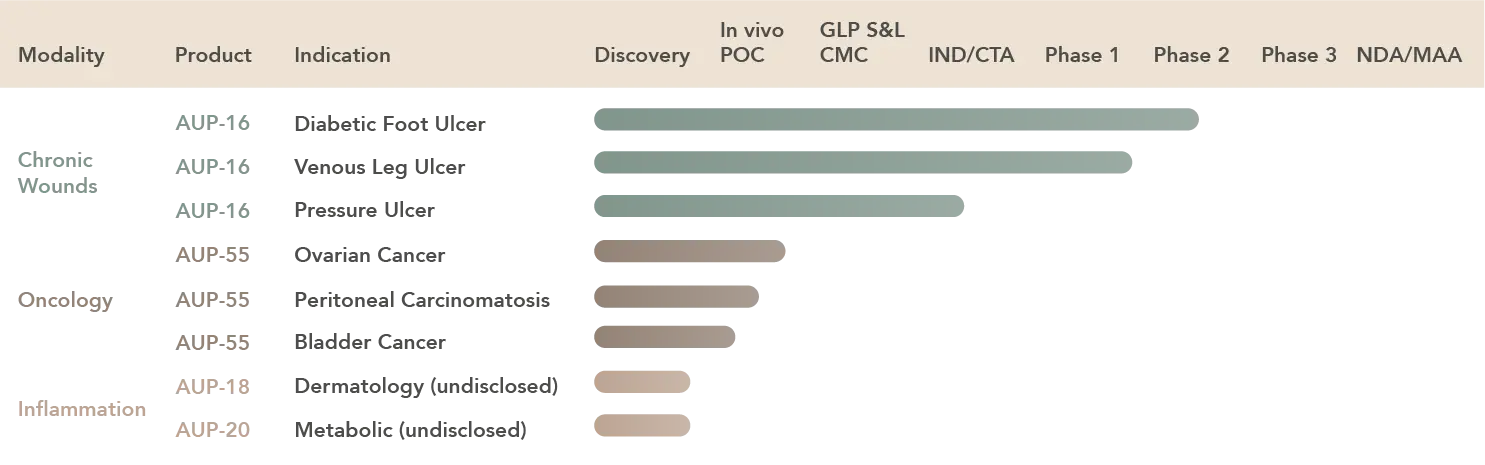
Aurealis Therapeutics develops multi-target cell and gene therapies using its modular bacterial platform based on genetically engineered Lactococcus cremoris. Products from our platform produce multiple therapeutic proteins simultaneously in the diseased tissue, the only company globally to achieve three-protein expression in bacteria. Pipeline spans chronic wounds (Phase 2 completed), oncology (preclinical), and inflammation (discovery).
OUR PRODUCT PIPELINE IS ORGANIZED AROUND THREE THERAPY AREAS:
Lead product: AUP-16
Our Phase 1 clinical study in Diabetic Foot Ulcer (DFU) patients was completed with excellent results. The first patient in our Phase 2 clinical study in DFU was dosed in August 2023, and the last patient completed treatment in October 2024. Blinded evaluator results are expected in Q3 2025. Clinical trials in Venous Leg Ulcer (VLU) and Pressure Ulcer (PU) will follow.
Lead candidate: AUP-55
We have obtained pre-clinical results in ovarian cancer and other secondary peritoneal carcinomatosis. Our first abstract was accepted and published at ASCO website.
3. INFLAMMATION
Lead candidate: AUP-60
At discovery stage.
| Therapeutic Area | Product | Discovery | In vivo POC | GLP, S&T, CMC | IND/CTA | Phase 1 | Phase 2 | Phase 3 | NDA/MAA |
|---|
Why Chronic Wounds Resist Conventional Treatment
There is no effective treatment that can hit multiple targets as one product.
We believe that when treating complex diseases like chronic inflammation and cancer, one needs to hit multiple targets to be disease-modifying. Very few companies or products can claim to truly target multiple biological targets. With our 4-in-1 technology, we can.
The wound healing process, for example, involves multiple steps: inflammation, proliferation, angiogenesis, and epithelialization. This process occurs naturally in normal circumstances. However, in chronic non-healing wounds, this process is impaired — wounds remain in the inflammation stage. To successfully restart wound healing in chronic non-healing wounds, it is essential to activate different biologic targets.
AUREALIS THERAPEUTICS 4-IN-1 PRODUCT AUP-16

Even though many different treatments exist today – traditional or moist wound dressings, negative pressure wound therapy, cell and tissue-based products, skin substitutes, and growth factors – most existing products only tackle one target with a single mode of action.
That is why we created Aurealis Therapeutics 4-in-1 platform.
How the Aurealis Bacterial Gene Therapy Platform Works
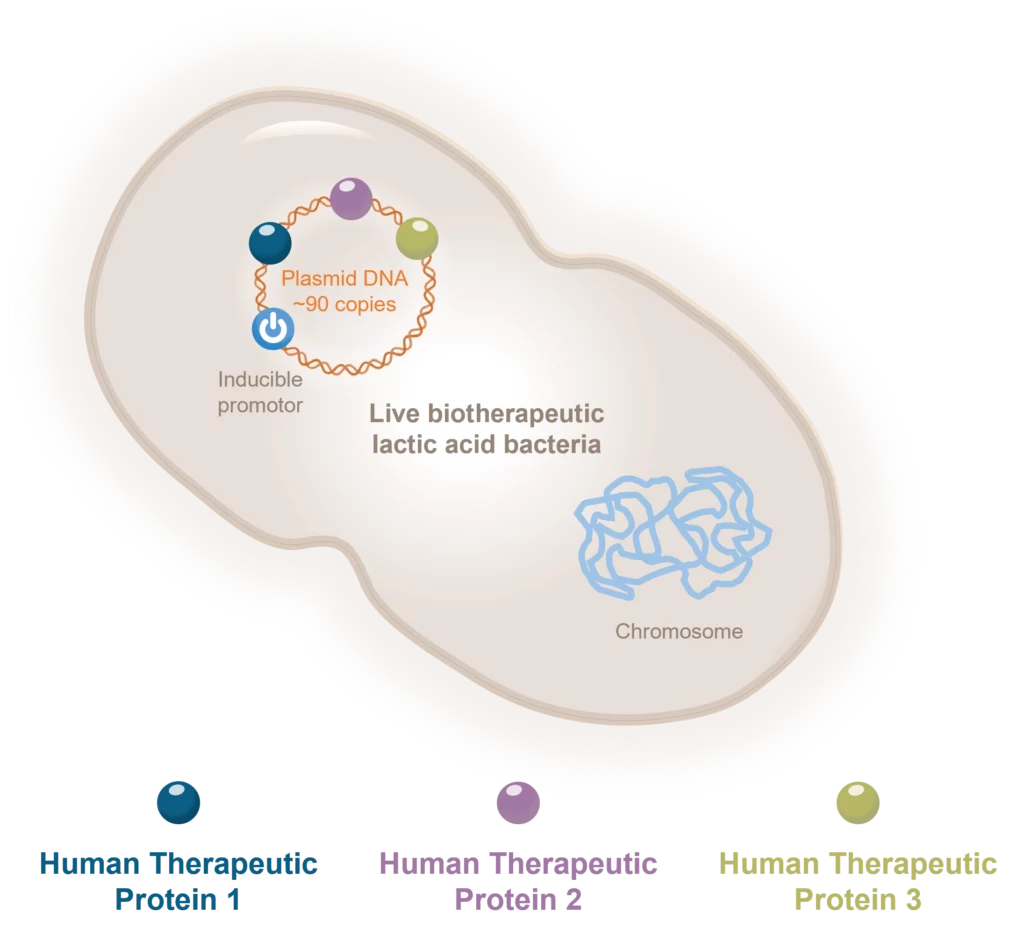
A synthetic biology, cell and gene therapy platform based on modified food-grade lactic acid bacteria. These bacteria are genetically modified to include 90 copies of a plasmid, allowing them to synthesize multiple human therapeutic proteins, acting as millions of bioreactors in the body.
We are the only company in the world to have genetically engineered bacteria expressing three human therapeutic proteins.
This novel cell and gene therapy platform is backed by pre-clinical and clinical results in wide-ranging applications from diabetic foot ulcers, other non-healing wounds, oncology and inflammatory diseases.
A synthetic biology, cell and gene therapy platform based on modified food-grade lactic acid bacteria. These bacteria are genetically modified to include 90 copies of a plasmid, allowing them to synthesize multiple human therapeutic proteins, acting as millions of bioreactors in the body.
We are the only company in the world to have genetically engineered bacteria expressing three human therapeutic proteins.
This novel cell and gene therapy platform is backed by pre-clinical and clinical results in wide-ranging applications from diabetic foot ulcers, other non-healing wounds, oncology and inflammatory diseases.
Our Bacterial Gene Therapeutic Areas
Frequently Asked Questions
01. What is bacterial gene therapy for chronic wounds?
Bacterial gene therapy for chronic wounds uses genetically engineered, non-pathogenic bacteria applied directly to a wound to continuously produce and release human therapeutic proteins at the site of injury. Rather than delivering a fixed drug dose, the living bacteria act as millions of nanoscale bioreactors, secreting growth factors and cytokines exactly where the wound needs them. Aurealis Therapeutics pioneered this approach using Lactococcus cremoris, a food-grade bacterium engineered to produce three therapeutic proteins simultaneously — delivering combination biological therapy as a single product.
02. Why do chronic wounds such as diabetic foot ulcers fail to heal?
Diabetic foot ulcers fail to heal because diabetes simultaneously disrupts all four stages of normal wound healing — inflammation resolution, tissue proliferation, angiogenesis, and epithelialization — trapping the wound in a persistent, destructive inflammatory state. Macrophages remain locked in a pro-inflammatory M1 phenotype instead of converting to regenerative M2, new blood vessel formation is suppressed, and fibroblast activity is impaired [1]. Because the dysfunction is multi-factorial, single-target treatments cannot restart the healing cascade on their own. Between 1–2% of the population in developed countries suffer from chronic wounds at any given time [2], and diabetic foot ulcers account for more than 60% of all non-traumatic lower-limb amputations [1].
References:
03. What is the Aurealis platform?
The Aurealis Therapeutics platform is a modular synthetic biology cell and gene therapy platform based on Lactococcus cremoris — a non-pathogenic, food-grade lactic acid bacterium — genetically engineered to produce and release multiple human therapeutic proteins simultaneously at the disease site. It is the only platform in the world to have genetically engineered bacteria expressing three human therapeutic proteins simultaneously (h-CSF-1, h-FGF-2 and h-IL-4). Using an established bacterial backbone, a new customized product expressing 2–3 target proteins can be built in approximately six weeks, making the platform applicable across chronic wounds, oncology, and inflammation.
04. How does Aurealis's platform produce multiple therapeutic proteins from a single bacterium?
Each bacterium is engineered to carry approximately 90 copies of a multi-gene expression plasmid, turning every cell into a nanoscale bioreactor that continuously synthesizes and secretes multiple human proteins directly in the wound. The high plasmid copy number amplifies protein output per cell, and because production happens locally, therapeutic concentrations are sustained at the site of action without systemic exposure. All proteins produced are accepted by regulators as a single Active Pharmaceutical Ingredient (API), avoiding the complexity of a traditional multi-drug combination.
05. What are the advantages of using lactic acid bacteria as a drug delivery vector?
Lactococcus cremoris has centuries of safe use in food fermentation, carries Qualified Presumption of Safety (QPS) status from EFSA and GRAS status from the FDA, and produces no endotoxins — making it inherently safer than gram-negative bacterial vectors or viral gene therapy vectors. Because the bacteria produce therapeutic proteins locally and continuously, they achieve sustained high concentrations at the wound without systemic side effects or the rapid degradation associated with single-dose protein application. Fermentation-based manufacturing of lactic acid bacteria is well established at industrial scale, enabling low cost of goods — a critical factor for broad patient access.
References:
06. What results has AUP-16 shown in clinical trials for diabetic foot ulcers?
In the completed Phase 1 study, 83% of patients with non-healing diabetic foot ulcers achieved complete wound closure at the recommended Phase 2 dose, with zero recurrences during 12 months of follow-up [1]. In the Phase 2 DIAMEND randomized controlled trial (64 patients, 10 sites across Germany, Italy, and Poland), AUP-16 administered twice weekly achieved a complete wound closure rate of 64% versus 20% in the placebo group (+44%, p < 0.05, Per Protocol population) and 60% versus 24% (+36%, p < 0.05, Intention-to-Treat population), both in patients with chronic DFUs of more than three months’ duration. No serious adverse reactions or safety concerns related to AUP-16 were observed [2]. Final DIAMEND results were presented by Prof. Alberto Piaggesi at the EWMA 2026 conference in Bremen, May 2026.
References:
07. What peer-reviewed publications support Aurealis's technology platform?
The Aurealis Therapeutics technology platform is supported by peer-reviewed journal articles, clinical study publications, and conference presentations at leading medical societies including EWMA and ASCO.
The full and up-to-date publication list is available at: aurealistherapeutics.com/pipeline-and-science/#publications.
08. How does multi-target gene therapy differ from single-target wound treatments?
Single-target treatments — including growth factor products, wound dressings, negative pressure therapy, and skin substitutes — each address only one aspect of the wound healing process, leaving the other disrupted pathways untreated [1]. Aurealis Therapeutics’ 4-in-1 platform simultaneously targets chronic inflammation (via IL-4-driven M2 macrophage conversion), angiogenesis and granulation tissue formation (via FGF-2), and immune microenvironment remodeling (via CSF-1) — all delivered as a single API [1, 2]. The clinical impact of this approach was demonstrated directly in the DIAMEND Phase 2 trial: AUP-16 achieved a 3.2-fold higher complete wound closure rate than placebo plus standard of care [3].
References:
- doi:10.1177/20420188241294134
- Aurealis Therapeutics. DIAMEND Phase 2 results press release. December 4, 2025. aurealistherapeutics.com
Peer-Reviewed Publications and Clinical Evidence
Prof. Alberto Piaggesi presented the results of our DFU Phase-2 clinical study during an oral presentation at the European Wound Management Association (EWMA) Conference Bremen 2026 titled: Results of Phase-2 Randomized Controlled “DIAMEND” Study with Multi-targeting Cell & Gene Therapy AUP1602-C in Chronic Neuro-Ischemic Diabetic Foot Ulcers. Access the presentation.
Aurealis Therapeutics had a poster presented at the Symposium on Advanced Wound Care (SAWC) Charlotte 2026 titled: Final results of Phase-2 Randomized Controlled “DIAMEND” Study In Chronic Diabetic Foot Ulcer With Topical Multi-Target Cell & Gene Therapy AUP1602-C Access the poster.
Aurealis Therapeutics had an abstract published and an e-poster presented at the European Wound Management Association (EWMA) Conference Barcelona 2025 titled: A randomized controlled Phase 2 trial to evaluate multi-factorial gene therapy AUP1602-C in the management of non-healing Diabetic Foot Ulcer. Access the abstract. Access the e-poster.
Aurealis Therapeutics published a scientific article in the Therapeutic Advances in Endocrinology and Metabolism peer-reviewed journal titled: Multi-target gene therapy AUP1602-C to improve healing and quality of life for diabetic foot ulcer patients: a phase I, open-label, dose-finding study. Access the scientific article.
Aurealis Therapeutics presented an abstract and a poster at ISPOR Health Economic Conference titled: A Markov model to determine the cost-effectiveness of a multi-targeting bacterial gene therapy (AUP-16) at healing a Diabetic Foot Ulcer when compared to the current standard of care. Access the abstract and the poster.
Aurealis Therapeutics presented a poster at the 14th International Symposium on Lactic Acid Bacteria titled: Multi-target bacterial gene therapy for chronic wounds and cancer. Access the poster.
Aurealis Therapeutics’ abstract titled Effect of multi-targeting bacterial gene therapy on tumour regression and survival in mouse models of ovarian and intraperitoneal cancer was accepted for publication at the Journal of Clinical Oncology, an American Society of Clinical Oncology (ASCO) Journal. Access the abstract.
Aurealis Therapeutics gave an oral presentation at the European Wound Management Association (EWMA) Conference Milan 2023 titled: 4-in-1 live biotherapeutic Gene Therapy Medicinal Product (GTMP) accelerates healing of Diabetic Foot Ulcers (DFUs): a first-in-human, phase 1 clinical study. Access the oral presentation.
Aurealis Therapeutics published a scientific article in the PLOS-One journal titled: 4-in-1 Combination therapy using Lactococcus lactis expressing three therapeutic proteins for the treatment of chronic non-healing wounds. Access the scientific article.
Aurealis Therapeutics presented a poster at the European Wound Management Association (EWMA) Conference Krakow 2018 titled: Therapeutic use of Lactococcus lactis bacteria to produce proteins locally in diseased tissues of chronic wounds. Access the poster.